You’re staring at a half-finished estimate for a bathroom remodel. You know exactly how long it should take, but you also know that old plumbing has a nasty habit of turning a two-hour job into a two-day nightmare. Do you charge by the hour to protect yourself, or give a flat fee to win the client’s trust?
It’s the classic "Pricing Paradox" that keeps small business owners up at night. Charge too little, and you’re paying for the privilege of working. Charge too much (or too vaguely), and the client ghosts you for the cheaper guy who probably won’t show up anyway.
After 20 years in this industry, I’ve seen great contractors go under simply because their math was slightly off. That’s why we are thrilled to announce the release of our newest free resource: the Hourly Rate vs. Flat Fee Converter.
This isn't just a calculator; it’s a sanity saver. In this post, we’re going to break down the pros and cons of both pricing models, how to use our new tool to guarantee profitability, and how to seamlessly transition from calculating the number to getting paid.
The Great Debate: Hourly vs. Flat Rate
Before we crunch the numbers, let’s look at the philosophy. Your pricing model isn't just about money; it’s about the experience you’re selling to the customer.
The Hourly Model
Best for: Troubleshooting, open-ended repairs, and "can of worms" projects.
- Safety Net: You get paid for every minute you work. If the rusty bolt snaps, you aren't working for free to fix it.
- Scope Flexibility: If the client adds "just one more thing," the clock keeps ticking.
- Transparency: Clients know exactly what they are paying for—your time.
The Flat Fee (Project) Model
Best for: Installations, standard maintenance, and defined deliverables.
- Profit Scaling: If you quote for 4 hours and finish in 2, you just doubled your hourly rate.
- Client Comfort: Clients hate surprises. A fixed price removes the fear of a runaway bill.
- Cash Flow: Easier to collect deposits and manage invoicing schedules.
Stop Guessing, Start Calculating
We built the Hourly Rate vs. Flat Fee Converter because we saw too many pros doing mental math in the driveway of a client's house.
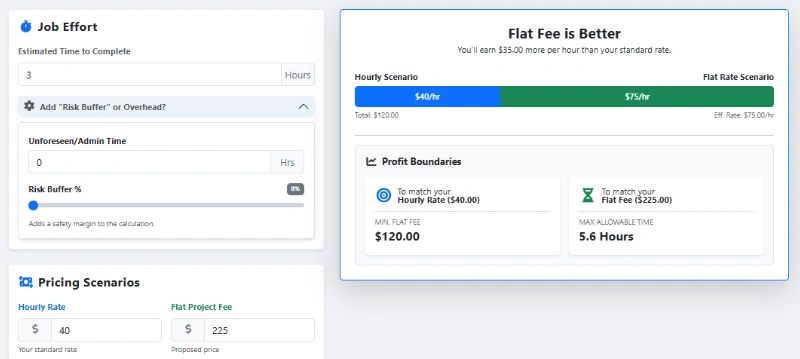
This tool allows you to input your desired annual salary, overhead costs, and billable hours to reverse-engineer exactly what you need to charge. It then lets you compare that against a flat fee to see which model yields a higher effective hourly rate.
Why it matters: If you quote a flat fee of $500 for a job that takes 6 hours, but your target hourly rate to cover overhead is $95/hr, you actually lost money on that job. Our tool flags this instantly.
5 Hidden Costs Your Price Must Cover
Whether you use our converter or a napkin, if you aren't factoring in these five elements, your business is a hobby, not a company.
1. Non-Billable Time
Driving, buying materials, and creating estimates in WorkQuote takes time. If you bill 40 hours a week, you're likely working 55.
2. Vehicle Wear & Tear
Gas is obvious. Tires, oil changes, and the eventual replacement of your work truck are often forgotten.
3. Software & Tools
From your drill bits to your business management software, these are recurring costs.
4. Taxes & Insurance
Self-employment tax hits hard. Liability insurance is non-negotiable for serious contractors.
5. Profit Margin
Salary pays you. Profit pays the business so it can grow. Don't confuse the two.
From Calculation to Quote
Okay, you used the Hourly Rate vs. Flat Fee Converter and decided that a flat rate of $1,200 is the sweet spot for that landscaping job. Now what?
This is where the amateur separates from the professional. You don't text that number to the client. You present it professionally.
1. Create the Estimate
Use WorkQuote to generate a branded PDF estimate. It looks official and builds trust instantly.
2. Schedule the Job
Once they approve the digital quote, convert it to a scheduled job with one tap.
3. Get Paid
Send the invoice immediately upon completion. Speed of invoicing is directly tied to speed of payment.
How This Applies to Your Trade
Plumbers & Electricians
Flat rate is king here. A client doesn't care how long it takes to replace a water heater; they just want hot water. Using the converter helps you ensure your flat rate covers the "what ifs" of old piping.
Landscaping & Lawn Care
Maintenance is usually flat rate (per mow), but hardscaping (patios, retaining walls) can be tricky. Use the calculator to compare your material markup + labor against a lump sum to see where the profit lies.
Painters
This is almost exclusively a flat fee game based on square footage. However, using the hourly converter helps you audit your speed. If your square foot price translates to $15/hour, you need to raise prices or paint faster.
Cleaning Services
First-time cleans should often be hourly (you don't know how dirty it really is), while recurring cleans switch to flat fee. Our tool helps you calculate that conversion perfectly.
Value Your Time, Grow Your Business
The biggest mistake I see small business owners make isn't bad workmanship; it's bad math. You are the expert. You provide a service that your clients cannot do themselves. Your pricing should reflect that value, not just cover your gas money.
Go ahead and bookmark the Hourly Rate vs. Flat Fee Converter. Use it on your next three bids. Once you have the numbers right, let WorkQuote handle the heavy lifting of scheduling, invoicing, and organizing your business.