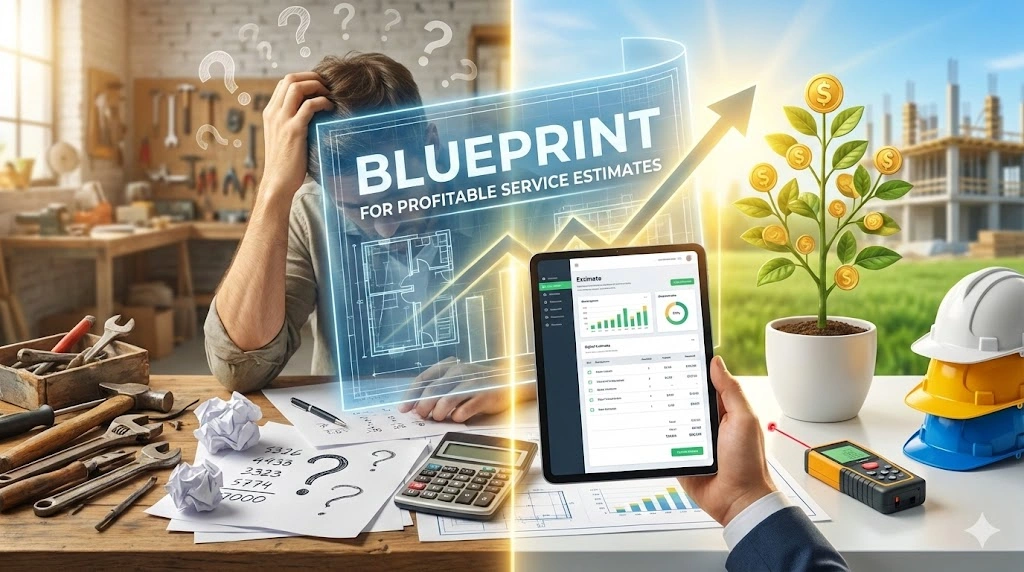
It is 7:30 PM. You have spent the last ten hours fixing other people's problems—installing unit heaters, landscaping backyards, or rewiring a kitchen. You are covered in dust, your back aches, and all you want is a hot shower and a meal. But you can't rest yet.
Instead, you are sitting at your kitchen table, surrounded by crumpled receipts, scribbled notes on the back of business cards, and a calculator. You are trying to remember exactly how much copper pipe you used on the Johnson job or whether you promised the Smiths a discount on their spring cleanup.
This is the "invisible shift"—the administrative nightmare that plagues thousands of small business owners in the home service industry. It is the time when profit is either secured or lost in the margins of a notepad.
If you are still running your service business on paper, spreadsheets, or disjointed mental math, you aren't just losing time; you are actively bleeding revenue. In an era where customers can order a car ride or dinner with a single tap, the tolerance for handwritten, slow, or vague estimates is vanishing.
In this guide, we are going to dismantle the old way of doing things. We will explore how modernizing your workflow—from estimation to invoice—is the single biggest lever you can pull to scale your operations, secure more jobs, and actually get paid for the value you provide.
1. The Psychology of Speed: Why "I'll Get Back to You" Loses Jobs
In the service industry, speed is a currency as valuable as cash. When a homeowner discovers a leaky pipe or a broken fence, they are experiencing anxiety. They want a solution, and they want it now.
The old school approach is to visit the site, take notes, drive home, type up a quote in Word or Excel, and email it two days later. By the time your quote hits their inbox, three things have likely happened:
- The customer has fixed the issue themselves (poorly).
- The urgency has faded, and they decided to wait.
- Most likely: A competitor using a mobile app gave them a price on the spot and booked the job before you even started your truck.
Modern estimating software changes this dynamic entirely. Imagine standing in the client's driveway, inputting the line items on your phone, and emailing a branded, professional PDF estimate before you even shake their hand goodbye. This isn't just about efficiency; it is about confidence. It tells the client, "I am organized, I am professional, and I value your time."
2. Perception is Reality: The Power of a Branded Estimate
You might be the best electrician in the county. Your craftsmanship might be flawless. But if your invoice is a generic, carbon-copy slip from an office supply store with coffee stains on the corner, you are underselling your worth.
Price resistance often stems from a lack of trust. When a client sees a messy estimate, they subconsciously worry about a messy job site. Conversely, when they receive a digital document featuring your logo, clear line items, terms of service, and a breakdown of costs, the price becomes easier to justify.
Using tools that allow for customized branding elevates you from a "handyman" to a "business partner." It sets the tone for the entire relationship. If your paperwork is crisp, the client assumes your work will be too.
3. The Expense Black Hole: Where Profit Goes to Die
Profitability isn't just about charging more; it is about leaking less. One of the greatest dangers for independent contractors is the separation of expenses from jobs.
You buy materials at the supply house at 8:00 AM. You buy fuel at 10:00 AM. You pick up a specialty tool at 1:00 PM. By the end of the week, those receipts are scattered across your dashboard, your pockets, and your laundry. When it comes time to invoice the client or do your taxes, those costs are forgotten.
Every untracked expense is a donation you are making to your client.
The Solution: Real-Time Tracking.
The moment you buy materials, they should be logged against the specific job ID. This does two critical things:
- It ensures you bill the client for reimbursable materials immediately.
- It gives you an accurate "Job Profitability" report later. You might think you made $500 on a job, but after factoring in the forgotten sealant and extra trip charge, you might have only made $200. You need to know that data to adjust your future pricing.
Business reports are not just for corporations. Even a solo window cleaner needs to know which months are slow and which services yield the highest margins.
4. Turning "One-Offs" into Recurring Revenue
The most expensive part of any service business is acquiring a new customer. Once you have them, the gold mine lies in retention. Yet, many contractors finish a job, get paid, and never speak to the client again.
Digital organization allows you to maintain a database of your clients. Did you clean their gutters this fall? Your system should remind you to reach out next fall. Did you install an HVAC unit? You should be scheduling their annual maintenance check-up.
This is where Job Scheduling transitions into Lead Generation. By keeping your schedule organized in an app rather than a paper calendar, you can identify gaps in your week. You can look back at past clients and generate work during slow seasons.
Don't leave your customer list in a notebook that could get lost. Your customer data is the equity of your business. Treat it like gold.
5. Removing Friction from Payment
"The check is in the mail." It is the phrase every contractor dreads.
Cash flow kills more small businesses than lack of work. If you are waiting 30, 60, or 90 days for payment because you rely on paper invoices sent via snail mail, you are acting as a bank for your customers—interest-free.
Modern consumers are trained by e-commerce giants to pay instantly. They want to click a button and be done. If you force them to find a checkbook, buy a stamp, and find a mailbox, you are adding friction. Friction causes delays.
Invoicing
Send invoices immediately upon job completion via email or text. Don't wait until the weekend.
Tracking
Know exactly who owes you money. An app doesn't feel awkward sending a reminder; you might.
By utilizing a digital platform to track payments, you can see your accounts receivable at a glance. You can identify who the chronic late payers are and perhaps choose not to work with them in the future—or require a deposit upfront. This is the power of data over gut feeling.
Stop Being an Employee of Your Own Business
There is a significant difference between owning a business and owning a job. If the business stops running the moment you put down your wrench or paintbrush because you are the only one who understands the paperwork, you own a job.
Transitioning to a digital, all-in-one system for estimating, scheduling, and invoicing allows you to build systems. Systems scale. Systems allow you to hire help without chaos. Systems allow you to take a vacation without your revenue drying up.
You went into business to build a future, not to be a slave to paperwork. It is time to reclaim your evenings. It is time to stop guessing at your prices and start growing your bottom line. Check out the rest of our blog posts for more tips on running a smarter service business, or explore how WorkQuote can transform your daily workflow.